
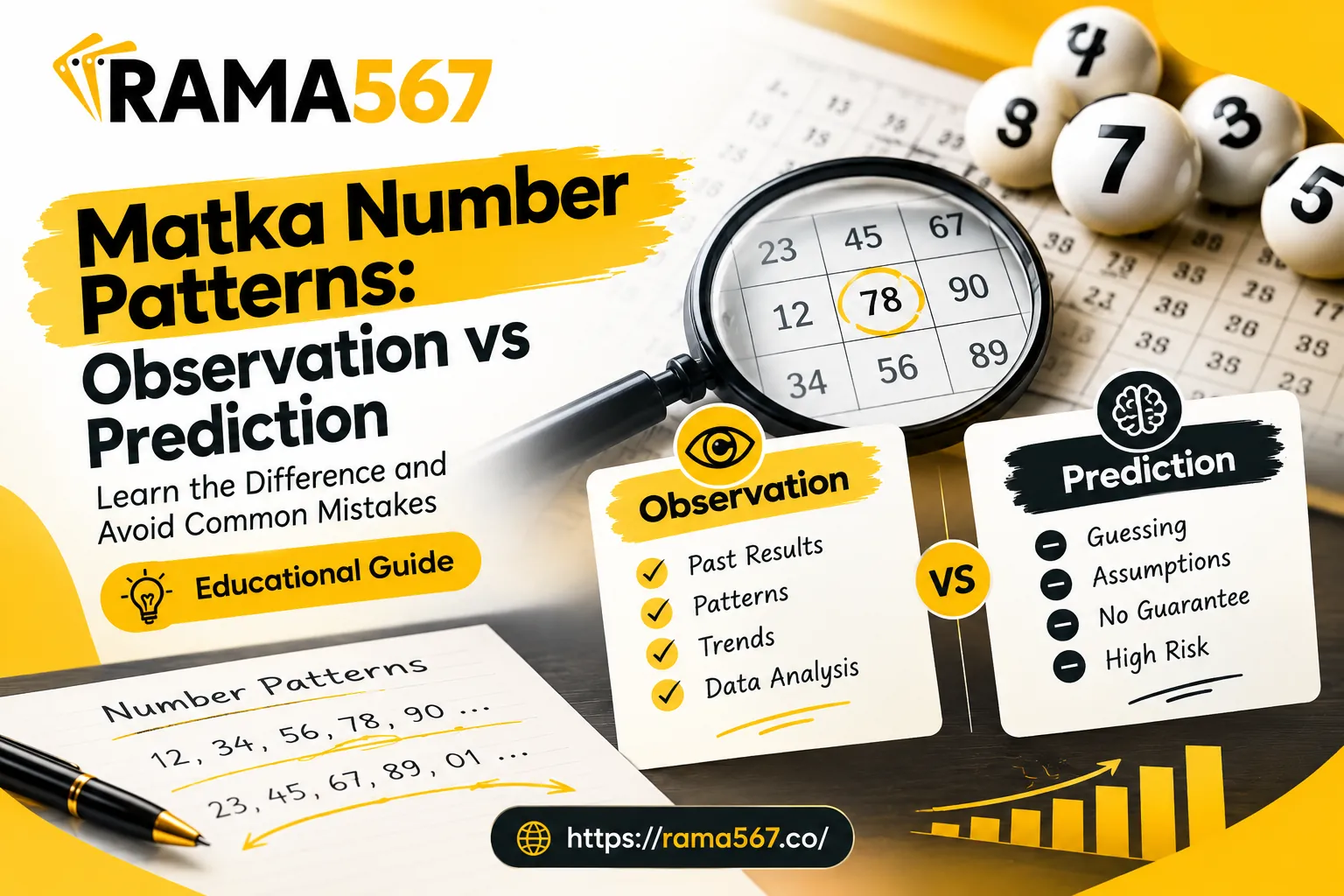
When looking back over past results, it’s easy to see patterns form. You’ll easily notice numbers that appear in sequence, values that regularly fail to appear, or sets of digits that alternate consistently over the course of weeks. It can feel easy to assume that you’ve found a system, but it’s an easy mistake to confuse regularity with intentionality.
When learning to interpret historical results, understanding the difference between observation and prediction is the most important lesson any beginner will learn. Spotting a pattern in past records is an observation, but assuming that these trends will shape the future is a prediction. It’s a very common beginner error to conflate the two.
What Are Matka Number Patterns?
When reviewing data, any repetition, consistency, or sequence within the listed values can be considered a pattern. When discussing the trends found in historical results tables provided by past Matka game sessions, people generally mean:
- Repeated Values: Sets of the same number found in consecutive or regularly spaced sessions
- Symmetry: Repeating sequences or numerical patterns (14, 24, 34 or alternating odd/even values)
- Gaps: Periods in which a particular value was not recorded
- Frequency: Clusters of high-value entries that appear more regularly than other digits
It’s important to note that while these trends may form interesting and consistent-looking sequences, they only describe what has occurred rather than what will occur in future records.
Why Do People Look for Meaning in Patterns?
Humans are naturally drawn to finding meaning in what they see or experience. Our minds are powerful tools that allow us to recognize connections between seemingly unrelated concepts by identifying the ways in which they relate. These abilities give us our capacity for language, empathy, and socialization – but they can also lead us to mistakenly believe that something occurred by design.
When applied to a table of numbers, our natural desire for connection can lead us to mistakenly believe that a set of digits found in consecutive sessions represents an intentional pattern rather than a random, statistically likely occurrence. Recognizing repeated sequences helps us understand how the world works, but failing to separate observation from assumption leads to inaccurate predictions.
Observation: Past Entries Prediction: Future Assumptions
| OBSERVATION (Past Facts) | PREDICTION (Future Assumptions) |
|---|---|
| • Factual & verifiable | • Unverified assumption |
| • Describes what occurred | • Claims to know what will occur |
| • Grounded in historical tables | • Reaches beyond the dataset |
| • Holds zero predictive weight | • Treats history as a guarantee |
Observation
An observation is always a purely factual statement. It can only contain elements that were actually recorded in the source data. An example of an observation would be a statement like “Number 48 appeared in both Tuesday’s and Wednesday’s evening sessions.”
Prediction
A prediction always contains an element of assumption. It states a fact about something that has already occurred, then goes beyond the known information to claim knowledge about something that has not yet happened. A prediction would be a statement like “48 appeared in Tuesday’s and Wednesday’s evening sessions, which means that it will appear again on Thursday.”
To further understand the difference between these terms, and how to apply these concepts to historical records, see our beginner’s guide to reading past results.
Common Patterns That Beginner Players Often See
When interpreting these records for the first time, many players are surprised to learn that some of most common formations they’ll see don’t actually indicate anything at all. Sets of numbers like those below are completely normal to see in random records, and their appearance has no bearing on future results:
The Short-Term Streak
One number or end-digit appears 3 times in a row. While this can seem like a clear sign that the value will continue to appear, short-term streaks are common in random records and do not control future outcomes.
The Long-Term Gap
One number does not appear for 30+ days in a row. Gaps of any length have no bearing on future results – players should treat a number that has not appeared in 3 weeks the same way they would a value that has not appeared in 3 days.
Alternating Pairs
Two values alternate with each other for several days in a row (12 89 12 89). While these alternating patterns can appear in random records, they do not indicate that the trend will continue in future results. The same applies to any other repeated pattern of digits.
The appearance of any of these patterns is completely normal – but assuming that they have any impact on future results is a very common mistake that new players make.
Why Can Historical Patterns Be Misleading?
Patterns can be misleading if their context is not fully understood. There are several common pitfalls that can cause someone to mistakenly believe that a pattern indicates future results.
Timeframes Are Often Too Short
Patterns tend to be most noticeable when they appear across very short windows of time. Someone examining a 5-day span of results might see repeating values and incorrectly assume that the pattern will continue throughout the month. If the same person were to examine a 6-month span of results, they would likely see that the pattern they thought they saw only appeared during those few days.
The Fallacy of Hindsight
Patterns in results records are easy to spot after the fact, but someone who sees a set of alternating numbers recorded on consecutive days may forget that they did not know what would happen next before the pattern appeared. It’s not possible to base future projections on past outcomes if those outcomes have already occurred.
Cherry-Picking Successes Without Considering Failures
When evaluating whether a pattern has real predictive value, it is critical to analyze how often it occurred alongside entries that did not produce results. Someone analyzing a set of repeated sequences might remember the 3 times that the pattern produced a winning number, but only consider the 50 times that it failed to do so.
The best way to understand why these patterns have no bearing on future results is to examine the mechanics that produce them. For more information about how randomness and independent probability work, see our beginner’s guide to Matka number mechanics.
Frequency Does Not Indicate Future Probability
Another common pitfall for beginners is to confuse frequency with probability. Someone analyzing a results table for 90 days might find that certain numbers appeared much more frequently over that span than others, but this does not indicate that those numbers are more or less likely to appear in future sessions:
Historical Record (Past 90 Days) Future Baseline Odds (Next Draw)
| Historical Results | Probability in a Future Draw |
|---|---|
| Digit '7' appeared: 18 times | Digit '7' probability: Equal |
| Digit '2' appeared: 6 times | Digit '2' probability: Equal |
| Digit '9' appeared: 11 times | Digit '9' probability: Equal |
(Reflects past distribution) (System has zero memory)
In any independent probability system like Matka, historical frequency does not affect future results. Past performance has no bearing on future results, and every session begins with the same baseline odds.
How to Carefully Analyze Historical Records
If you need to examine historical records for research, documentation, or website verification purposes, approach the data in a careful, systematic way:
Examine Large Datasets
It can be easy to examine a 7-day span of results and draw conclusions about the entire year based on the appearance of one value across 3 consecutive days. To avoid this pitfall, always evaluate larger sets of data before drawing any conclusions.
Verify Publisher Information
Before beginning analysis, confirm that the results table you are examining came from an official Matka results source and contains properly recorded dates and values. For more information about why this matters, see our guide to Matka result publishing standards.
Use Well-Formatted Archives
Tables that span large amounts of data can appear cluttered or difficult to parse at first, but this can lead to critical errors in analysis. Archives that use clear formatting and result website features designed for readability make it much easier to examine smaller sections of data without accidentally misinterpreting an entry’s value or placement.
Document Observations Without Assumptions
When recording information for research or documentation purposes, only make note of facts that are clearly present in the source data. Avoid making assumptions about future or past values, and keep detailed records about any clarifications that were necessary to understand the source material.
Consider Display Differences Across Devices
Some users may attempt to access historical records from mobile devices, but this can make data interpretation significantly more challenging. Always examine how a results table will appear on the device you intend to use before beginning analysis. For more information about this issue, see our beginner’s guide to viewing Matka results online.
Common Misinterpretations to Avoid
When analyzing past results, it is critical to avoid certain common misinterpretations that can lead to inaccurate conclusions:
- Do not say a value is “due” to appear based on how long it has been since it was last seen
- Do not assume that a short-term trend has any bearing on future results
- Do not assume that a winning pattern is guaranteed to continue after it has appeared
- Do not draw conclusions about cause and effect from unrelated past events
- Do not mistake an unlikely, coincidental combination of digits for a sign of a hidden system
Also Read: How to Verify Online Matka Results Before Trusting Them
Key Takeaways for New Players
When examining past results, always remember the following information:
- Observations are statements about the past, but they hold no predictive value
- Predictions are guesses about the future, and guesses about the future are never accurate
- Small sample sizes produce highly variable results – do not draw conclusions about large sets of data based on a few days’ worth of information
- Independent probability systems like Matka have no memory of past results, and every session will always have the same baseline odds
- Always verify that you are examining the correct dataset, and make sure that date labels and column headers have been interpreted accurately
Conclusion
Observing the data and predicting future results based on it may be confusing for some Matka result statistics beginners. The appearance of the same digits, gaps, alternations, and other numerical patterns can be misleading, as they tend to be random in the Matka game.
To avoid confusion when studying historical performance statistics, it is essential to remember that every data collection refers to a specific date, column, source, and volume. In addition, it never hurts to take a step back and look at a bigger picture when examining such information.
As a result, it becomes much easier to keep an objective perspective on the numbers and see them as facts devoid of any intrinsic meaning rather than potential predictors of the future results.
Frequently Asked Questions
1. What are Matka number patterns?
Matka number patterns refer to repeated, alternating, or otherwise consistent sequences of numbers or values that can be found when examining past results.
2. Can patterns in historical results be used to predict future numbers?
No. Patterns in historical records only describe what has already occurred, and independent probability systems like Matka have no memory of past results. Therefore, any pattern in past records can be used to describe what occurred, but not what will occur in future records.
3. What is the difference between an observation and a prediction?
An observation is a statement about something that has already occurred, while a prediction is a statement about something that has not yet occurred.
4. Why do values appear more frequently in some records than others?
Any independent probability system will produce occasional streaks and periods of increased frequency due to variance.
5. How should beginners examine these patterns?
Beginners should always treat patterns in historical records as observations about the past, rather than predictions about the future. They should analyze large sets of data rather than small samples, verify that the dates and labels within a dataset are correctly interpreted, and make sure that they fully understand the difference between observation and prediction.